Poem of the Week, by Günter Grass

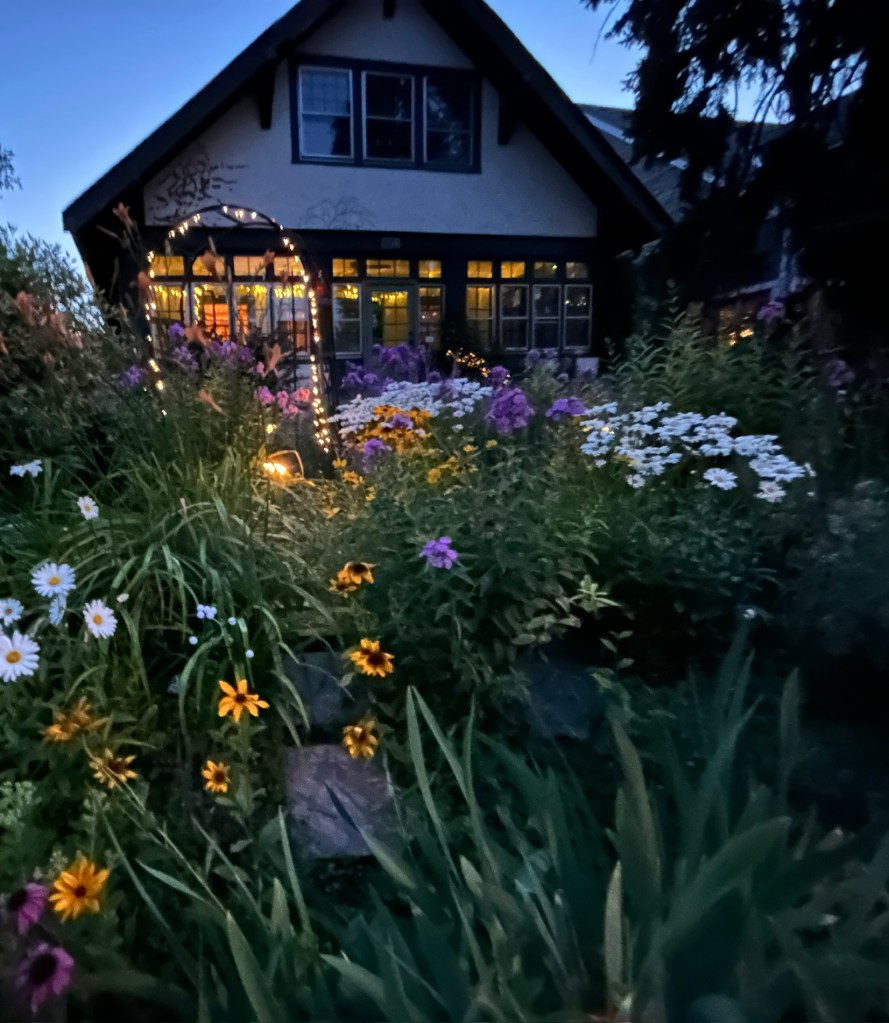
It’s spring and ICE or not, things are heating up here at Poetry Hut central. Poems disappear at a rapid clip and I scurry to keep up: Print, Slice, Scroll, Rubber Band while bingeing a show. Passersby stop and choose a poem, read it, smile, shake their heads, put it in their pocket to take home. If you find yourself in south Minneapolis, stop by.

A few fun facts about operating a poetry hut:

1. People greatly prefer poems printed on neon paper. Violent pink and intense teal are always the first to go. Sadly for me I don’t like neon but I am here to serve the poetry public, so neon it is.
2. People do not like yellow poems. Yellow poems are always the last to go.
3. Some people read their poem, then carefully scroll it back up, replace the rubber band, and put it back in the hut. For some reason this goes straight to my heart.
4. Some passersby leave poems of their own making, written on scrap paper I leave in the hut. Others write down their own favorite poems, ones they must have memorized, like the beautiful poem below I found when returned from a run slow jog.

Poetry, oh poetry. It’s where loneliness goes to remind itself it’s not alone.

Happiness, by Günter Grass

An empty bus
hurtles through the starry night.
Perhaps the driver is singing
and is happy because he sings.

For more information about Günter Grass, please click here.
alisonmcghee.com
Words by Winter: my podcast

Jon Dee Graham, 1959-2026

You know how sometimes you hear a song and it’s as if that song has lived inside you your whole life but only now do you realize it? Love at first listen. Tracy Chapman’s Fast Car was like that for me, and so was the first Jon Dee Graham song I ever heard, Something Wonderful Is Going to Happen. His voice came roaring out of the speakers in my little Mazda-3 and that was it, I was a lifer.

From that moment on I tracked down every Jon Dee song I could find and listened to them obsessively. That giant voice, that guitar, the everything he put into his music that everyone who ever heard him felt. I bought his CDs, because back then I still had a CD player, and a few years ago I bought a record player so I could buy his albums.

Jon Dee was a lifelong Texan. He lived in Austin but he used to tour every year, and one of the cities he came to regularly was Minneapolis, where I live. Many years ago I saw he would be in town, but only for a private house party. I messaged him –the first time I ever reached out–to ask if he would be playing anywhere else in town. Let me check on something, he wrote in response. Later that day he told me the people hosting the party were fine with having me show up. So down to a suburb I drove, into a house full of people I didn’t know, and I sat on a folding chair in the front row of their living room.

There he was, my music idol. Every song he played, I knew, and I tried not to sing along but it was hard not to. After the set he went outside to smoke and I followed him and introduced myself. Alison! he said, and gave me a hug.

That summer evening, which hangs in my memory, was long ago. I keep trying to remember the details of how we became such good friends but they’re fuzzy. Maybe because everything is a little fuzzy since last Friday, when I first heard of his death. I’m so sorry, my friend Al messaged me, and instantly I knew Jon Dee was gone. It’s hard to write those words. Hard to remember, each day since, that he’s not in this world anymore. Hard to think of how my phone won’t light up with another text from him, some little message that no matter what the topic will make me smile, if only because it came from Jon Dee.

After that first house concert I went to see him play if I were anywhere near. Once, when I was in Austin on a book tour during SXSW, I Ubered to a restaurant/bar where he was playing, sat at a table in the dark and ordered a drink. At some point he called out to the audience, wanting to know the farthest anyone had come. I called out “Minneapolis!” and he shaded his eyes and peered out into the dark room and said in a wondering voice, “Alison? That’s not you, is it?” It was.

Years later, he asked me to help him with a picture book he was writing and illustrating –he was also an artist–and we worked together for a long time. Me teaching him what I know about picture books, him instantly absorbing it all.

You’re pan-artistic, JD, I texted him at one point. I mean damn. Songs. Artwork. Writing. Storytelling. What’s next? Ballet?

Hmm, he texted back. Not LIKELY. But not UNLIKELY either! I’m tryin not to rule anything out.

Another time, in Minneapolis, he had a show in one of my favorite tiny venues, The Listening Room. He came out on stage with his guitar, sat down, tuned up, then looked out at the audience. He saw me near the front, and without a word, came down into the audience and gave me a huge, silent hug. Writing that makes me choke up. I don’t even know why. Maybe because Jon Dee saw something in me, something kindred?

Whatever it was he saw in me, he saw in everyone. He had an uncanny ability to see people, to divine their heart and soul, and an equally uncanny ability to somehow, no matter the circumstance, comfort others. In the pandemic he went online each week to read picture books to his followers, calling himself Tio Pantalones and greeting everyone he saw sign on.

Jon Dee was a big man with a big voice and a big smile and an enormous, tender heart that he ripped out of his chest over and over and over, in every song he wrote and every story he told. His talismanic creation was The Bear, a gruff, tender bear portrayed in so many of his paintings, and the subject of the beautiful children’s book he wrote and illustrated. He identified with the Bear, he told me once, but he didn’t go into detail.

Some losses hit harder than others. The night Al messaged me, I wandered around my house, crying. But there was no one to cry with, because none of my friends but Al knew Jon Dee. I spooled up all my favorite JDG songs and listened to them on repeat. Went to bed and woke up and remembered that he was gone and my heart broke again, the way it does, morning after morning, in the wake of someone you loved so much.

I didn’t want to grieve alone but what could I do? Go online. I opened up my laptop. I’m not sure I’ve ever seen such a spontaneous outpouring of grief, so many people just like me, filled with sorrow for our lost legend. It is somehow a comfort to see this, and to know that so many others are sending their love to Jon Dee’s wife and sons, who were so beloved to him that his voice usually dropped to a whisper when he talked to me about them.

Why did he have to die when the monsters just keep, on, living? Why Jon Dee, when every day they double down on cruelty and greed and he just made the world better for everyone? I wailed to the Painter. Dumb question, without an answer, but still, why?

Little things around my house are all Jon Dee: a mug I bought at one of his shows, some artwork he sent me, his albums. Jon Dee did not believe in encores –he always said they were kind of doofy, like okay, we’ll all walk off stage and wait a minute, and then we’ll all walk back on and play another song–so he always played a full set and more, giving us his whole heart every time.

And then poof, he was gone.

My favorite song of his is Faithless.

The story of your life
Written page by page
Careful what you write
You gotta read it all someday

You need a strong heart
You need a true heart
You need a heart like that
In a world like this

Poem of the Week, by Ursula K. Le Guin

So many of the things humans kill about are invisible and imaginary and almost arbitrary. The boundaries between nations. Nations themselves. The systems and rules we create and then accept and live by, like capitalism, like patriarchy, like religion, like a country that withholds health care and security and money from its own people because it would rather give its eight hundred billionaires even more power and money, like a president who’s happy to send children who aren’t his to war. It’s all hard for me to wrap my head around. See you at No Kings.

The Next War, by Ursula K. Le Guin

It will take place,
it will take time
it will take life,
and waste them.

Click here for more information about Ursula K. Le Guin.​

alisonmcghee.com
My podcast: Words by Winter

Poem of the Week, by Amanda Quaid

Once, long ago when she was tiny, one of my daughters was asking me about death, and if everyone had to die, even me.

I wanted to reassure her so I told her if something happened to me her father would take very good care of her, and she would miss me terribly but she would be okay.

I wouldn’t miss you, she said, in an untroubled way.

You…wouldn’t?

Nope. Because I’d be dead too. I couldn’t live without you.

*

Patient and Daughter Appear Closely Bonded, by Amanda Quaid

My toddler takes a bite of tater tot and tells me
she wants me to die.

The social worker says I should respond and not
react to things like that

so I ask why she says she wants me to die
as though it’s just

a thought-provoking notion that has never
crossed my mind.

She thinks for a moment, chewing, her tiny lips
stained with blueberry juice.

“I want you to die so you can show me
how to die.”

I take that phrase and tuck it in my breast—she’s
given me a gift, I know,

a task or blessing or could it be—would you not
call it permission—

“And you could come back as a peacock!” she cries
with a grin

“And so could I, and then we could be friends!”
She cackles at me and I smile

back at her and see us in the next
go-round, two peacocks

preening our plumes in the Sri Lankan sun,
finally peers and bickering

over the last mangosteen
in the grove.

Click here for more information about Amanda Quaid. 
alisonmcghee.com
My podcast: Words by Winter
Poem of the Week, by Tess Gallagher

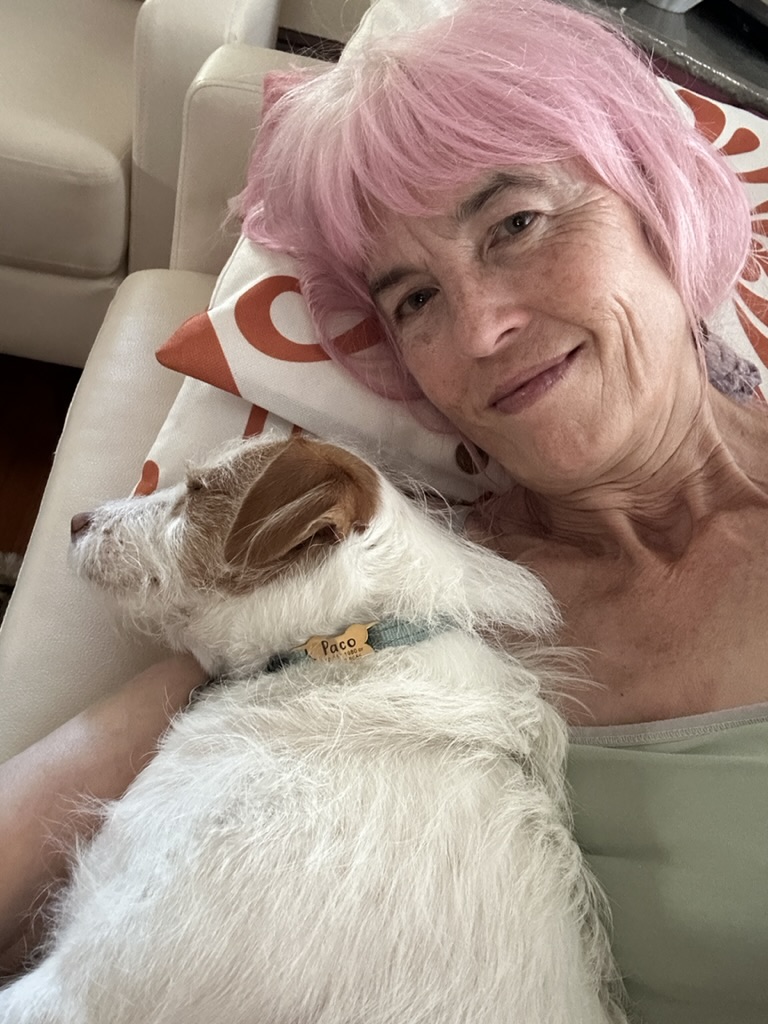
Friends, I’m leading a FREE creative writing workshop via Zoom this coming Friday, March 20, 1-4 pm Central Time. Rewriting the Story, Reclaiming the Self is designed for anyone living with the memories of abuse: bullying, domestic violence, an emotionally abusive relationship, a sexual or physical assault. I’d love to see you in the room. Email me if you’d like to sign up. 

Sort through blackberries. Pick out ones too far gone and toss them into a compost pail. Next to you other volunteers bag mushrooms, sort apples, count boxes of organic greens and other donated supplies. How many people will this one afternoon of work feed? Not enough, you think, and suddenly your blackberry task seems so dumb. Futile.

When your own government seems bent on destroying everything you’ve worked for your whole life, when people you didn’t elect and despise are dropping bombs on little kids, are swinging their heedless wrecking balls against everything you hold dear, how can you feel anything but despair?

That’s how they want you to feel, Alison, you tell yourself, for the thousandth time, and you look up from the blackberries, around the big room filled with people working steadily to help others, to take care of them when the people who control the money won’t. This is the flip side of the brutality coin. This is what you have to remind yourself of, every day, all day.

Most of us don’t want to cut down the nests. Keep going, you tell yourself, and you do.

Choices, by Tess Gallagher

I go to the mountain side
of the house to cut saplings,
and clear a view to snow
on the mountain. But when I look up,
saw in hand, I see a nest clutched in
the uppermost branches.
I don’t cut that one.
I don’t cut the others either.
Suddenly, in every tree,   
an unseen nest
where a mountain   
would be. 

                              (for Drago Štambuk)

Click here for more information about poet and short story writer Tess Gallagher. Today’s poem appears in her collection Midnight Lantern: New and Selected Poems, published in 2011 by Graywolf Press. 

alisonmcghee.com
My podcast: Words by Winter
Poem of the Week, by Sharon Olds

Friends, I’m leading a FREE creative writing workshop via Zoom on Friday, March 20, 1-4 pm Central Time. Rewriting the Story, Reclaiming the Self is designed for anyone living with the memories of abuse: bullying, domestic violence, an emotionally abusive relationship, a sexual or physical assault. I’d love to see you in the room. Email me at alisonmcghee@gmail.com if you’d like to sign up. 

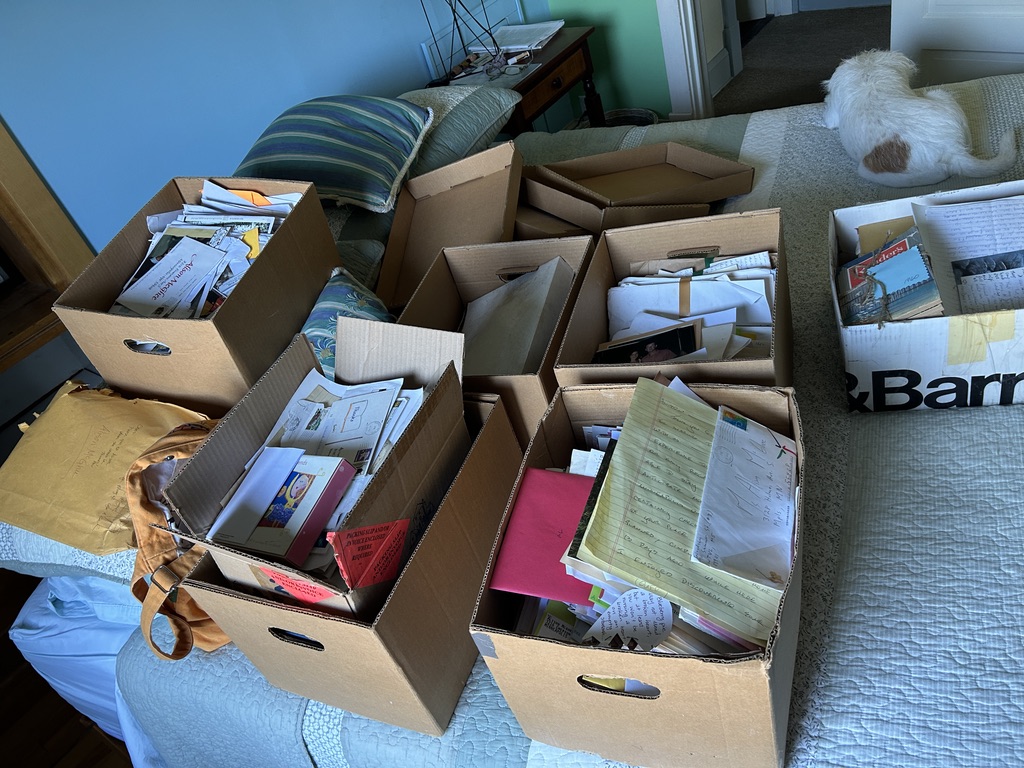
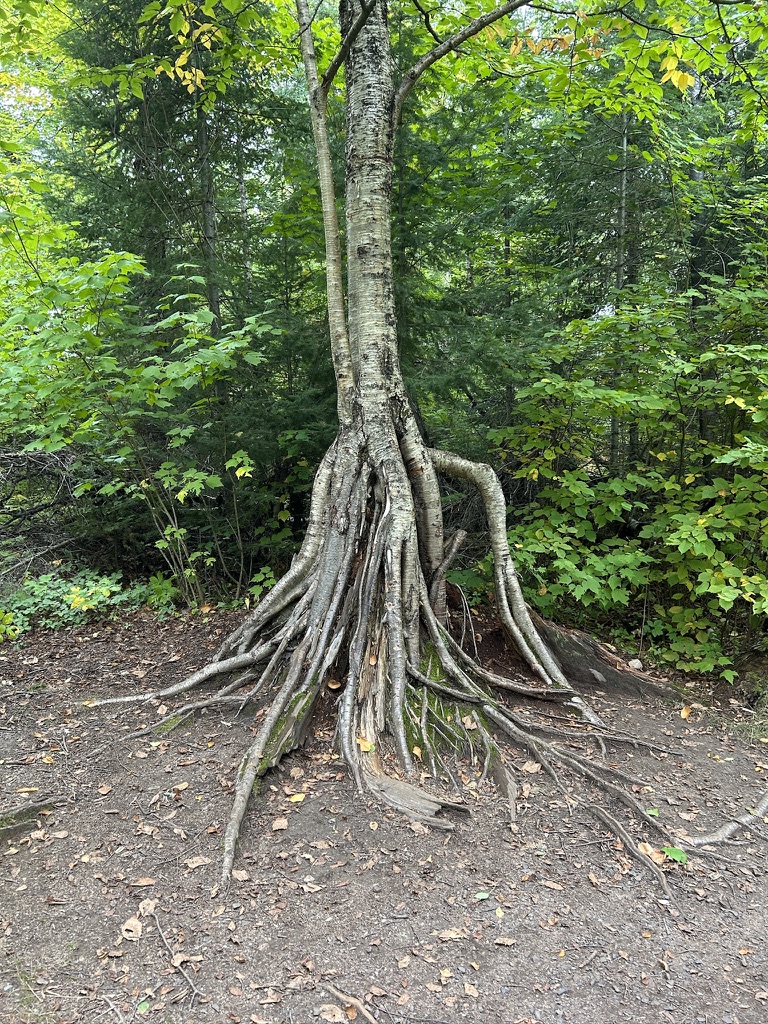
I miss the pace of snail mail. I miss the anticipation of a letter and the tactile feel of it in my hands. In a tiny never-used room at the top of my house are bins and boxes full of all the pre-email letters I’ve never been able to throw away.

Last November I added a new box to the storage room, a small Whitman’s candies box filled with the letters my father sent my mother daily from basic training. I couldn’t open any of those letters, couldn’t open them, couldn’t couldn’t couldn’t, and then, one morning last week, I did.

My father was a giant man with a hot temper who terrified me as a child. But my God, these letters. His hidden gentleness, his love and longing for my mother, are in every one of those handwritten missives. So much innocence and excitement about their upcoming wedding. In his letters I see the decency of a young, good man who had fallen in love, whose whole life was yet to come. I know him so much better now.

My Father’s Diary, by Sharon Olds

When I sit on the bed, and spring the brass
scarab legs of its locks, inside
is the stacked, shy wealth of his print.
He could not write in script, so the pages
are sturdy with the beamwork of printedness,
WENT TO LOOK AT A CAR, DAD IN A
GOOD MOOD AT DINNER, LUNCH WITH MOM,
TRIED OUT SOME RACQUETS—a life of ease,
except when he spun his father’s DeSoto on the
ice, and a young tree whirled up
to the hood, throwing up her arms—until
LOIS. PLAYED TENNIS WITH LOIS, LUNCH
WITH MOM AND LOIS, DRIVING WITH LOIS,
LONG DRIVE WITH LOIS. And then,
LOIS! I CAN’T BELIEVE IT! SHE IS SO
GOOD, SO SWEET, SO GENEROUS, I HAVE
NEVER, WHAT HAVE I EVER DONE
TO DESERVE SUCH A GIRL? Between the tines
of his W’s, and liquid on the serifs, moonlight,
the self of the grown boy pouring
out, kneeling in pine-needle weave,
worshiping her. It was my father
good, it was my father grateful,
it was my father dead, who had left me
these small structures of his young brain—
he wanted me to know him, he wanted
someone to know him.​ 

Click here for more information about the wondrous Sharon Olds. Today’s poem is from Blood, Tin, Straw, first published by Knopf in 1999. 


alisonmcghee.com
My podcast: Words by Winter
Poem of the Week, by Shilpa Kamat

Friends, I’m leading a FREE creative writing workshop via Zoom on Friday, March 20, 1-4 pm Central Time. Rewriting the Story, Reclaiming the Self​ is designed for anyone living with the memories of abuse: bullying, domestic violence, an emotionally abusive relationship, a sexual or physical assault.​ Email me if you’d like to sign up. 

Remember when things used to not be evil? When life was normal? I overheard someone saying into their phone the other day, and I started to silently agree, then stopped.

Normal used to mean my grandmother couldn’t vote, my mother had to hide being pregnant with me to keep her job, that if you were gay you pretended you weren’t. Normal used to mean the legal enslavement of Black people.

If neighbors being abducted from their homes and sent to “detention” centers without due process begins to feel normal, if tiny children being gunned down in our schools begins to feel normal, if .1% of our population hoarding over half the money while most have no safety net at all begins to feel normal, then what’s evil?


the demons were never, by Shilpa Kamat 

evil just regular
                                      people who prayed
                                      and were granted

thunderbolts
ethers
                                      before their hearts
                                      were grown
enough to keep
up

For more information about Shilpa Kamat, please click here.

Poem of the Week, by Judith Viorst

Last summer my family and I were waiting for a new family member to arrive. I was in Boston with my daughter and son-in-law, hanging out. Making dinner. Watching movies. Writing. Teaching. Waiting, waiting, and hoping: for an uneventful birth, a quick recovery, a healthy baby.

In me as I waited were shadows, worry ghosts haunting me. Worry my daughter’s birth would be as hard as mine were, worry the baby would not be ready for the world, worry my daughter would suffer but keep it to herself. I tried to cope with these ghosts the way I cope with most things, by silently tripling down on determination.

It wasn’t until a few months after the baby was here that I understood the scared ghosts in me were remnants of my former self, that overwhelmed girl who never told anyone she couldn’t cope and just struggled through. And now here is this new presence, making us all laugh and smile, fixing us with those bright brown eyes. Sometimes, if we’re lucky, we get a chance to comfort our past selves.

Between Mother and Other

My heart is younger, higher than  
at any time since I held 
your beginning life against it. 
The mirror does not lie, 
I am as my mother was, 
as I, of course, would never be. 
On this day of days, time is gracious. 
It has, I think, a special fondness
for first-time grandmothers
and so leaves one thing unchanged –
I love your daughter as I loved
the daughter cradled in my
arms, that long ago yesterday when
I was you, and you were she. 

​Today’s poem is by Judith Viorst, poet and author of books for adults and children, including Alexander and the Terrible, Horrible, No Good, Very Bad.
alisonmcghee.com
My podcast: Words by Winter
Poem of the Week, by Kim Addonizio

A few years ago a minor heart glitch I was born with spiraled out of control and needed fixing. I didn’t want to worry anyone so I stayed quiet until just before the procedure. But as the masked nurses pushed the gurney into the OR, I suddenly felt terrified. I don’t want to die, I said. Please don’t let me die.

Their eyes filled with surprise and they all immediately bent over me. Everything will be okay. We’ll take good, good care of you. And then I was under the lights and then I was floating away and then I was waking up to the surgeon, standing at the end of the bed with his arms crossed, grinning. Do you remember telling us to stop setting your heart on fire? 

That whole day came washing back over me when I read this poem below. The kindness of the nurses and doctors. The wondrousness of a world in which a heart can be precisely burned in multiple places and emerge okay. The openheartedness of an unknown person who, long before their own death, chose to save another’s life with their own body. The knowledge that we get just one heart, and whether we’re conscious of it or not, it’s always on fire.

February 14, by Kim Addonizio

This is a valentine for the surgeons
ligating the portal veins and hepatic artery,
placing vascular clamps on the vena cava
as my brother receives a new liver.

And a valentine for each nurse;
though I don’t know how many there are
leaning over him in their gauze masks,
I’m sure I have enough—as many hearts

as it takes, as much embarrassing sentiment
as anyone needs. One heart
for the sutures, one for the instruments
I don’t know the names of,

and the monitors and lights,
and the gloves slippery with his blood
as the long hours pass,
as a T-tube is placed to drain the bile.

And one heart for the donor,
who never met my brother
but who understood the body as gift
and did not want to bury or burn that gift.

For that man, I can’t imagine how
one heart could suffice. But I offer it.
While my brother lies sedated,
opened from sternum to groin,

I think of a dead man, being remembered
by others in their sorrow, and I offer him
these words of praise and gratitude,
oh beloved whom we did not know.


Click here
 for more information on the wondrous poet Kim Addonizio. Today’s poem first appeared in What Is This Thing Called Love, published by W.W. Norton in 2004. 

alisonmcghee.com
My podcast: Words by Winter
Poem of the Week, by Naomi Shihab Nye

The food share encourages volunteers to take home a bag of food for themselves. “I don’t feel right about that,” I said to my friend. “Why should I take a bag when I can afford to buy groceries?”

My friend looked at me calmly. “By not taking a bag, you set yourself apart from people who do. You implicitly demonstrate that those who volunteer here, the ones who can afford groceries, are somehow superior to those who come for food.”

This was one of those moments when the world suddenly pivoted a fraction of a degree for me. What is the current ICE occupation here but the action of people who perceive themselves to be superior?

Racism is core: the implicit assumption is that if your skin is not white and/or your English is accented, you are suspect. You can be hauled from your car, your school, your place of work, your asylum hearing, because you have been deemed automatically inferior by those currently in power in our administration.

Who am I to judge myself even remotely different from anyone else? I took a bag of food home with me and cooked up a big batch of soup to share with others. ❤️‍🩹

Kindness, by Naomi Shihab Nye

Before you know what kindness really is
you must lose things,
feel the future dissolve in a moment
like salt in a weakened broth.
What you held in your hand,
what you counted and carefully saved,
all this must go so you know
how desolate the landscape can be
between the regions of kindness.
How you ride and ride
thinking the bus will never stop,
the passengers eating maize and chicken
will stare out the window forever.
Before you learn the tender gravity of kindness
you must travel where the Indian in a white poncho
lies dead by the side of the road.
You must see how this could be you,
how he too was someone
who journeyed through the night with plans
and the simple breath that kept him alive.

Before you know kindness as the deepest thing inside,
you must know sorrow as the other deepest thing.
You must wake up with sorrow.
You must speak to it till your voice
catches the thread of all sorrows
and you see the size of the cloth.
Then it is only kindness that makes sense anymore,
only kindness that ties your shoes
and sends you out into the day to gaze at bread,
only kindness that raises its head
from the crowd of the world to say
It is I you have been looking for,
and then goes with you everywhere
like a shadow or a friend.

Click here for more information about Naomi Shihab Nye. Today’s poem is from Words Under the Words: Selected Poems, published in 1995.
alisonmcghee.com

My podcast: Words by Winter